
220.7K
Downloads
400
Episodes
Weekly conversations about the Liberal Arts and The Great Books with Wyoming Catholic College professors, board members,and guests.
Episodes

May 26, 2020
May 26, 2020
17 min
In early March, Wyoming Catholic College canceled all on-campus classes and like most—if not all—other colleges in America sent students home to resume classes at a distance.
Now it’s one thing to have a college that specializes in distance learning and there are schools today with no campus and no resident students. It’s quite another to retool nearly a semester of classes from face-to-face learning to distance. Our faculty put forth an heroic effort and the semester finished well.
In that effort they were led by our Dean Kyle Washut and asked Dean Washut to talk to us about the successes, difficulties, and things learned from our experiment in undergraduate distance education.
May 19, 2020
May 19, 2020
17 min
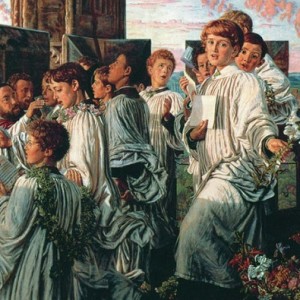
“Right from the beginning liturgy and music have been closely related. Wherever people praise God, words alone do not suffice. Conversation with God transcends the boundaries of human speech; everywhere it has, according to its nature, called on music for help, on singing and on the voices of creation in the sound of the instruments. Not only man has a role in the praise of God. Worship is singing in unison with that which all things bespeak.”
That quotation is from Joseph Ratzinger’s essay, “The Image of the World and of Man in the Liturgy and Its Expression in Church Music,” an essay Wyoming Catholic College juniors recently read for the course “Music in the Western Tradition.”
On this podcast, their professor, Dr. Stanley Grove comments on that essay and the nature of music in worship.
May 12, 2020
May 12, 2020
32 min
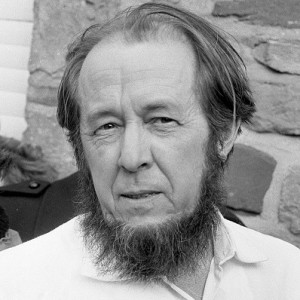
On June 8, 1978, Alexandre Solzhenitsyn went to Harvard University and delivered his now famous commencement address, “A World Split Apart.” It was, to say the least, not what people expected—or wanted.
By the time he delivered the Harvard commencement address, Solzhenitsyn had been living in the United States for some time, observing our politics and culture. In the address he offered a critique of our ideas of freedom and the good, of our sense of well-being, of our overall shortsightedness, and our lack of spirituality.
Wyoming Catholic College sophomores read Solzhenitsyn’s Harvard commencement address as part of Trivium 202: Political Rhetoric and the Common Good. In that course they not only study great examples of rhetoric, but learn to write and deliver their own speeches.
With those students at home across the land, Drs. Virginia Arbery and Pavlos Papadopoulos recorded this conversation about Solzhenitsyn.
May 5, 2020
May 5, 2020
13 min
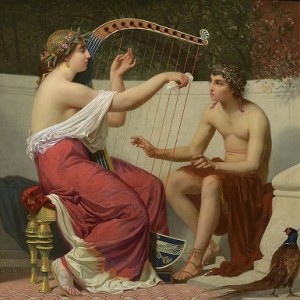
In the May 1991 issue of The Atlantic, poet Dana Gioia wrote, “American poetry now belongs to a subculture. No longer part of the mainstream of artistic and intellectual life, it has become the specialized occupation of a relatively small and isolated group. Little of the frenetic activity it generates ever reaches outside that closed group. As a class poets are not without cultural status. Like priests in a town of agnostics, they still command a certain residual prestige. But as individual artists they are almost invisible.”
Not only do we Americans not know our contemporary poets, we don’t read the poets of the past either. Poems are, for many of us, opaque. We simply don’t understand nor do we take the time to learn to understand, to appreciate, to love poetry.
With that in mind, Wyoming Catholic College president, Dr. Glenn Arbery has been on a mission: the revival of poetry. And he's begun a daily vlog on which he reads and comments on one poem a day: www.wyomingcatholic.edu/blog. Dr. Arbery is our guest on this episode of The After Dinner Scholar.
Apr 28, 2020
Apr 28, 2020
17 min
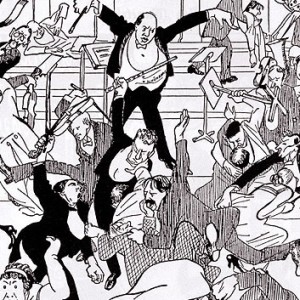
“You can kill people with sound," noted Estonian composer Arvo Pärt. Then he went on, “And if you can kill, then maybe there is also the sound that is opposite of killing. And the distance between these two points is very big. And you are free—you can choose.”
This is, perhaps an apt commentary on mid-20th century classical music. In this lecture to Wyoming Catholic College juniors, Dr. Stanley Grove discusses the musical works of Pärt as well as John Cage and Krzysztof Penderecki. Sounds that kill, sounds that bring life, and in the case of John Cage’s “4:33,” no sounds at all.
Apr 21, 2020
Apr 21, 2020
32 min
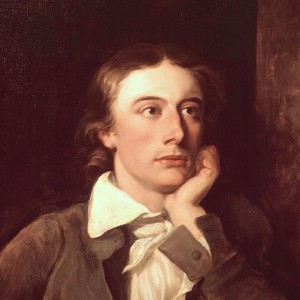
St. Agnes' Eve—Ah, bitter chill it was!The owl, for all his feathers, was a-cold;The hare limp'd trembling through the frozen grass,And silent was the flock in woolly fold:Numb were the Beadsman's fingers, while he toldHis rosary, and while his frosted breath,Like pious incense from a censer old,Seem'd taking flight for heaven, without a death,Past the sweet Virgin's picture, while his prayer he saith.
With those lines, the Romantic Era poet John Keats (1795-1821) began “The Eve of St. Agnes”(available here). A beadsman was someone whose duty it was to pray for his benefactor, the beads being the beads of the rosary.
While he prays in the chapel, in the adjacent castle, Keats tells us, Madeline dreams of her love for Porphyro, her family’s great enemy. Later that night Porphyro arrives at the castle and finds his way to Madeline’s bedroom. She wakes from a dream, the two declare their love for each other, and they run off together.
Dr. Glenn Arbery and Dr. Tiffany Schubert got together—online of course—to discuss the poem for the benefit of Wyoming Catholic College juniors listening at home.
Apr 14, 2020
Apr 14, 2020
35 min
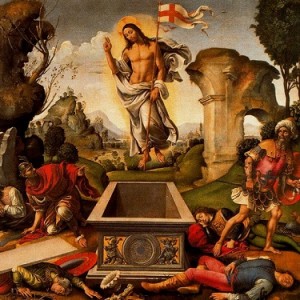
About 100 years ago, Frank Morison, an English journalist, set out to disprove the resurrection of Jesus by examining the facts. As a result Morison, the skeptic, came to believe that Jesus, the Son of God, crucified, dead, and buried, rose again to give eternal life. Morison’s book, Who Moved the Stone? is still in print today.
This being the Tuesday in the Octave of Easter, I thought of Morison’s experience as I listened to this week’s podcast—a conversation between Dr. Kent Lasnoski and Dr. Jeremy Holmes about faith and reason centering around Dei Filius, the dogmatic constitution of the First Vatican Council issued in 1870.
This document from the 19th century, we'll discover, speaks eloquently to our situation today.
Apr 9, 2020
Apr 9, 2020
28 min
St. Jerome famously said, “Ignorance of the Scriptures is ignorance of Christ.” Thus knowledge of the Scriptures is knowledge of Christ and the more we know Scriptures—assuming that our hearts are right—the more we will know Christ.
While reading through the Bible is of great value and scholarly study of the Bible is also of great value, the Medieval Masters developed a method of reading the Bible they called lectio divina—and it’s not just for monks in the Egyptian desert. It’s a mystical practice for all of us.
Dr. Baxter explains more addressing “How to Perform Scripture: Lectio Divina and Reading with the Heart” in this final session of “Into the Lenten Desert: Learning to Pray with the Medieval Masters” from Wyoming Catholic College.
Apr 6, 2020
Apr 6, 2020
21 min
Writing at TheCatholicThing, scholar David Bonagura, Jr. writes about Passion Sunday and the blessing and receiving of palms. It’s what we do, he says. Then he goes on, “But not this year. We will not be present to receive our palms, to hold them as the Gospel of Jesus’ triumphal ascent into Jerusalem is read, to make crosses out of them, to thread them through our crucifixes upon returning home. It is a Palm Sunday without palms.”
This year, Palm Sunday without palms will lead to Holy Thursday without our receiving the Eucharist, Good Friday without waiting on line to kneel and to kiss the crucified, and Easter without gathering in the dark to await the light and the resurrection. It is a strange and sad situation.
Here at Wyoming Catholic College, the sadness extends to the loss of our close-knit school community. Great gatherings for Easter brunches and Easter dinners will be limited to immediate family and groups of ten.
Last Friday, our academic dean, Prof. Kyle Washut spoke from his heart to the experience of our students, faculty, and staff. In doing so, he also, I suspect, speaks eloquently to you experience during this Holy Week. Here is what he had to say.
Apr 2, 2020
Apr 2, 2020
31 min
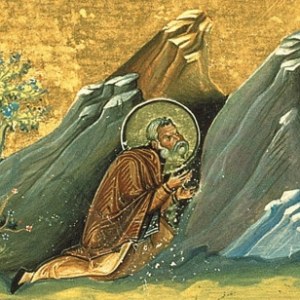
“The man who truly prayers,” wrote the fourth century monk Evagrios, “is the man who sees the place of God. This is what it means to be a theologian.”
This is lecture six in Wyoming Catholic College’s distance learning course “Into the Lenten Desert: Learning to Pray with the Medieval Masters” with Dr. Jason Baxter.
Following the example of St. Anthony, a steady stream of monks and hermits made their way into the Egyptian desert to seek God. Evagrios was among them, a so-called “desert father.”
In this lecture, Dr. Baxter looks at the writings of Evagrios and the sayings of the desert fathers in order to explain: “Praying with the Whole World: Evagrios and ‘Natural Contemplation.’”