

220.7K
Downloads
400
Episodes
Weekly conversations about the Liberal Arts and The Great Books with Wyoming Catholic College professors, board members,and guests.
Episodes

Aug 4, 2020
Aug 4, 2020
8 min
Let’s be honest. Participating in an academic class by sitting in front of a screen is not the same as being physically present with the professor and other students. On the other hand, given current technology, it’s not all that bad.
Dr. John Mortensen is a former Wyoming Catholic College professor and dean and President of the Aquinas Institute. Along with some current Wyoming Catholic College faculty who are also associated with the Aquinas Institute, Dr. Mortensen taught online during the COVID shutdown this spring. And while it was hardly perfect, nonetheless it worked pretty well.
As a result, Dr. Mortensen proposed that Wyoming Catholic College work with The Aquinas Institute to offer twelve distance undergraduate courses, The Great Books Core Curriculum. And this fall, that curriculum will be available for full academic credit.
Jul 28, 2020
Jul 28, 2020
13 min
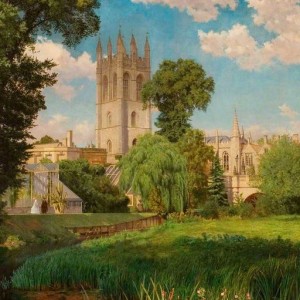
On September 1, 1939, Nazi Germany invaded Poland. On September 3, Great Britain declared war on Germany. On September 29, the Feast of St. Michael in the Anglican Church, the term began at Oxford University. Studies? Classes? Learning? In War-Time?
Academics at Wyoming Catholic College focuses on the great books of the liberal arts tradition—a tradition stretching back beyond the founding of Oxford in 1096. And Oxford in 1939 was still almost exclusively the liberal arts. What was the point of reading Homer, Herodotus, and Dante, studying Euclid, perfecting an understanding of Latin and Greek with a war going on?
On Sunday, October 22, 1939 at St. Mary the Virgin Church in Oxford, literary scholar and Oxford do C. S. Lewis stepped into the pulpit to answer that question? His sermon “Learning in War-Time” has become something of a classic and Dr. Jason Baxter studied that sermon earlier this month with high school students who attended Wyoming Catholic College’s PEAK Program.

Jul 21, 2020
Jul 21, 2020
16 min
“The heavens call to you and wheel about you,revealing their eternal splendors,” Virgil told Dante at the end of Purgatorio 14 (148-151),“but your eyes are fixed upon the earth.For that, He, seeing all, does smite you.”
While we could blame light pollution or television or lack of interest or any number of other modern maladies, but it’s clear that, just as in Dante’s time, the heavens call and wheel about and us most of us never notice. If, for example, you know the phase of the moon today, you’re part of a tiny, tiny minority of modern people. Virgil accuses us as well, “your eyes are fixed upon the earth.”
Dante lived at the turn of the 14th century and in his writing used a model of the universe conceived in the second century by astronomer and mathematician Claudius Ptolemy. Born in AD 100 in Alexandria, Egypt, Ptolemy argued from observation of the heavens that the earth (a sphere) was at the center and around it the moon, sun, planets, and stars rotated.
Clearly we no longer believe that, but Ptolemy still has a great deal to teach us about observing the sky and marking it’s beauty and regularity. Dr. Henry Zepeda taught Ptolemy, Copernicus, and Galileo with high school students who have been here at Wyoming Catholic College for our PEAK Program.

Jul 14, 2020
Jul 14, 2020
15 min
“The canyon of Lodore is twenty and three-quarter miles in length,” wrote Major John Wesley Powell who was the first to descended the Green River through the canyon in June 1869. “It starts abruptly at what we have called the Gate of Lodore, with walls nearly two thousand feet high, and they are never lower than this until we reach Alcove Brook, about three miles above the foot. They are very irregular, standing in vertical or overhanging cliffs in places, terraced in others, or receding in steep slopes, and are broken by many side gulches and canyons.”
Powell and his men found the river from the Gate of Lodore very tough going with multiple long portages around rapids and the loss of one of four boats along with a great deal of supplies and scientific instruments in what he named “Disaster Falls.”
Of course those were the days before nylon, gor tex, polyester fleece, and good strong river rafts, the kind used by the recent COR Expeditions rafting trip down the Green River. Bob Milligan, a 2018 graduate of Wyoming Catholic College now on COR staff led the trip.
For more information about COR Expeditions visit the COR website.
Jul 7, 2020
Jul 7, 2020
15 min
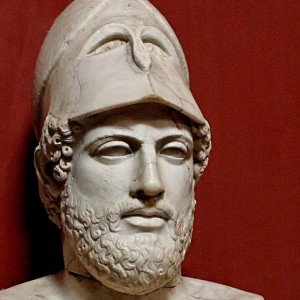
The Greeks finally defeated the Persian Empire in about 448 BC. When that war ended, the Athenians began to build an empire leading to a new war this one with their former allies. Central to the empire building and beginnings of the Peloponnesian War was the statesman Pericles.
During the first of our two two-week-long PEAK programs for high school students, Dr. Pavlos Papadopoulos taught a course about Pericles. His story is told by Thucydides in The Peloponnesian War and by Plutarch in Lives.
In the last of the speeches Pericles delivers in Thucydides’ account, Pericles tells an angry crowd, “And yet if you are angry with me, it is with one who, as I believe, is second to no man either in knowledge of the proper policy, or in the ability to expound it, and who is moreover not only a patriot but an honest one.” Was he really as good as all that? Was the age of Pericles truly the golden age of Athens?
Jun 30, 2020
Jun 30, 2020
12 min
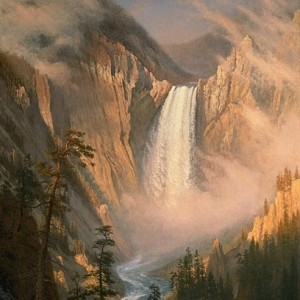
The well-laid plan was to fly to Maine for vacation, but it became clear that the travel restrictions there would make for a terrible vacation. So instead, Jim and Dottie Tonkowich drove north.
Their vacation trip of about 1,675 miles went from Lander to Cody, Yellowstone National Park, Three Rivers, Montana, Whitefish Lake, Montana, Glacier National Park, and back home via Butte, Montana, Yellowstone and the Tetons. If you’re thinking to yourself, “That must have been beautiful,” you’re on track with the topic of this podcast.
Beauty just may be the way to save our troubled world.
Jun 23, 2020
Jun 23, 2020
17 min
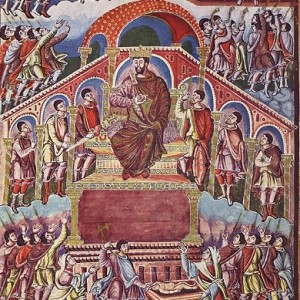
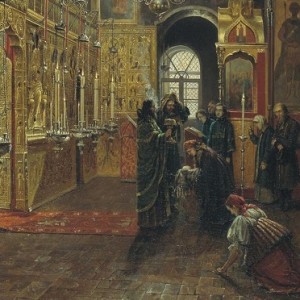
“One will observe,” wrote St. Thomas Aquinas, “that all things are arranged according to their degrees of beauty and excellence, and that the nearer they are to God, the more beautiful and better they are.”
While we hear the word “beauty” a great deal today—beauty products, beauty salons, beautiful people, “that fish was a beauty”—it’s safe to say that few people are thinking about beauty in the very Medieval way of St. Thomas, that the experience of beauty today is different than it was for Thomas’s contemporaries.
The question of the Medieval experience of beauty is one that Dr. Jason Baxter has been exploring this summer in a class for our friends at The University of St. Thomas and will continue to explore during the fall semester while he is on sabbatical.
Jun 16, 2020
Jun 16, 2020
15 min
In the past Wyoming Catholic College’s Byzantine chaplain, Fr. David Anderson has been a guest on The After Dinner Scholar so you know that our students are able to attend Byzantine Divine Liturgy regularly.
What you may not know is that while in the Western liturgical tradition, Mass can be celebrated without singing, in the Eastern rites, singing is mandatory.
Assisting Fr. David musically has been Prof. Christopher Hodkinson, Instructor of Music and Fine Arts who is also our Director of Music and our guest this week.
Jun 9, 2020
Jun 9, 2020
18 min
“Many people simply cannot believe that there can be a large, leisurely center to life where God can be pondered” wrote the late Dr. Eugene Peterson. “They doubt they can enter realms of spirit where wonder and adoration have a place to develop, and where play and delight have time to flourish. Is all this possible in our fast-paced lives?”
That 1994 article by Eugene Peterson was ironically entitled “The Good-for-Nothing Sabbath.” It had a profound influence on the way I thought about not only Sunday, but rest and leisure in general. It also served as the one of the first critiques I read of the modern American concept of time that sees each Sunday and holiday as nothing but “a day off” in the service of returning to work.
Dr. Kent Lasnoski here at Wyoming Catholic College has spent a good deal of time considering and writing about the Sabbath. And his concerns have only been amplified by the enforced fast from Sunday Mass and the sacraments due to COVID-19. We may have formed or enhanced some bad habits.
Jun 2, 2020
Jun 2, 2020
15 min
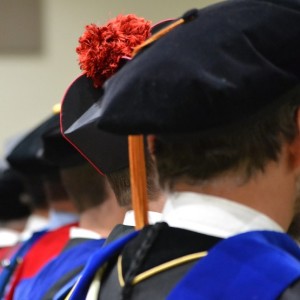
With the gracious blessing of our governor and our county officials, Wyoming Catholic College became one of the few schools in America to hold a face-to-face graduation.
On Saturday, May 23 capped, gowned, and hooded, thirty-six Wyoming Catholic College seniors received their Batchelor of Arts in Liberal Arts at an outdoor, socially-distanced ceremony. The night before at dinner—also outdoors and socially-distanced—college president Dr. Glenn Arbery addressed the seniors before presenting them with their iconic Stetson cowboy hats. Here is what Dr. Arbery had to say about their experience at Wyoming Catholic College and about our hopes for their futures.
Commencement was livestreamed for family and friends. You can watch it here.