

220.7K
Downloads
400
Episodes
Weekly conversations about the Liberal Arts and The Great Books with Wyoming Catholic College professors, board members,and guests.
Episodes
Mar 5, 2019
Mar 5, 2019
15 min
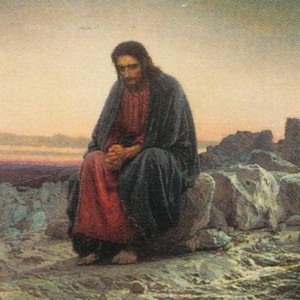
“Lent,” wrote New Testament scholar Dr. N. T. Wright, “is a time for discipline, for confession, for honesty, not because God is mean or fault-finding or finger-pointing but because he wants us to know the joy of being cleaned out, ready for all the good things he now has in store.”
And even if we already knew that, well… discipline and sacrifice come hard to most of us. As Pope St. John Paul II noted, “Our age, regrettably, is particularly susceptible to the temptation toward selfishness which always lurks within the human heart. …The spirit of the world affects our inner propensity to give ourselves unselfishly to others and drives us to satisfy our own particular interests.”
Lent is the needed antidote and our Wyoming Catholic College community takes Lent very seriously. Guiding us—students, faculty, and staff—through Lent is our college chaplain, Fr. Paul Ward. Fr. Ward is our guest this week on The After Dinner Scholar.
Feb 26, 2019
Feb 26, 2019
14 min
“Are not two sparrows sold for a penny?” told Jesus the fearful, “And not one of them will fall to the ground without your Father’s will. But even the hairs of your head are all numbered.” (Matthew 10:29-30)
God governs the vast reaches of space, the hosts of angels, the rise and fall of nations. And yet, little birds don’t fall to the ground dead “without your Father’s will.” And as your hair falls out, God keeps track of how many hairs remain.
This is a great mystery. It is the doctrine of God’s providence. “All things,” wrote St. Thomas Aquinas in his Compendium Theologiae, “are ruled by divine providence. “All things”? That’s quite an extravagant claim and, in our world of woe, it’s also quite a controversial claim.
Theologian, Dr. Michael Bolin provides some insights on this mystery on this edition of The After Dinner Scholar.
Feb 19, 2019
Feb 19, 2019
13 min
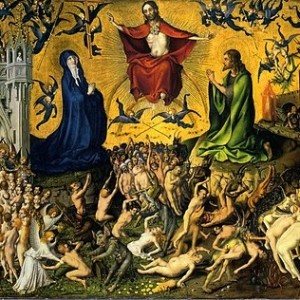
The Dies Irae, a hymn from the 12th century, speaks about the second coming of Christ and the Judgment Day. In addition to that, the Latin text just happens correspond with the Latin Wyoming Catholic College sophomores are learning right now.
It is, in fact, a powerful and challenging combination of poetry, theology, spirituality, and Latin grammar.
Noticing all that, Prof. Kyle Washut and Prof. Eugene Hamilton integrated a bit of second year Latin with second year Trivium. Prof. Washut is our guest this week on The After Dinner Scholar
Feb 12, 2019
Feb 12, 2019
14 min
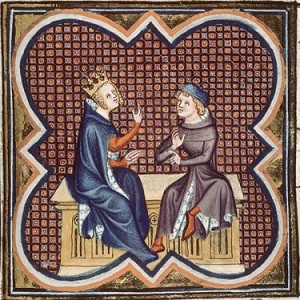
That nineteenth century German philosopher Friedrich Nietzsche’s point of view is incompatible with the vision, values, and mission of Wyoming Catholic College should come as no surprise to anyone. And the same can be said of thinkers such as Jean Jacque Rousseau, Sigmund Freud, Martin Heidegger, and Michel Foucault.
Yet Wyoming Catholic College students read all of them and more. And that makes sense since no one can understand our modern culture without confronting those thinkers.
Which brings up the question of how to read them—how to read any thinker with whom we disagree.
Dr. Tiffany Schubert has spent a long time thinking about how to read charitably, receiving even harsh and abrasive authors with kindness and sympathy.
Feb 5, 2019
Feb 5, 2019
15 min
Before C. S. Lewis was a novelist, spiritual writer, or Christian apologist, he was a scholar. Lewis served as a Fellow and Tutor in English Literature at Oxford University from 1925 until 1954 when he was made Chair of Medieval and Renaissance Literature at Cambridge University. That is Lewis’ primary calling was as a university professor and literary scholar.
His scholarly studies influenced all of Lewis’ writings from Narnia to the Space Trilogy from Screwtape to “The Weight of Glory” from The Abolition of Man to The Great Divorce and Till We Have Faces. Lewis’ popular books while speaking forcefully to our modern era are Medieval to the core.
Wyoming Catholic College Academic Dean Dr. Jason Baxter is, like Lewis, a student and scholar of Medieval and Renaissance literature. He has for years been reading over Lewis’s shoulder, studying the same books and authors.
This winter Dr. Baxter will be teaching a free distance learning course on “The Medieval Mind of C. S. Lewis.” To register, visit our website.
Jan 29, 2019
Jan 29, 2019
19 min
History is often concerned with great events—elections, revolutions, wars, battles, conquest, boom, and bust—and we’re used to reading history. That’s why we walk away slightly confused when someone says, “It must be borne in mind that my design is not to write histories, but lives.”
The ancient writer of Lives was the Roman Plutarch. His concern was character. "The most glorious exploits,” he wrote, “do not always furnish us with the clearest discoveries of virtue or vice in men; sometimes a matter of less moment, an expression or a jest, informs us better of their characters and inclinations, than the most famous sieges, the greatest armaments, or the bloodiest battles whatsoever.” His focus was “the marks and indications of the souls of men.”
Dr. Pavlos Papadopolous who has been teaching Plutarch this semester is our guest this week on The After Dinner Scholar.
Jan 22, 2019
Jan 22, 2019
12 min
Mortimer Adler, legendary founder of the Great Books program at the University of Chicago observed, “In the case of good books the point is not how many of them you can get through, but rather how many can get through to you.”
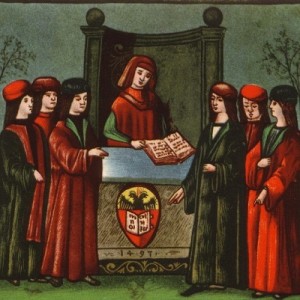
While we hope that many of the books our students read in their four years at Wyoming Catholic "get through" to them, spring semester of junior year we provide a special opportunity to read one author deeply and thoughtfully. We call it Trivium 302, but it’s better known as the Junior Author Project
In the fall of junior year, each student selects an author whom he or she wishes to know more deeply. In the spring, under the tutelage of professors, the student reads one major and one minor work of that author along with a biography and the most important critical scholarship pertaining to their author and then writes a final paper.
One of the professors guiding students in their Junior Author Projects is our guest, Dr. Kent Lasnoski.
Jan 15, 2019
Jan 15, 2019
14 min
“Life,” wrote the great Roman author Cicero, “is nothing without friendship.” And thus it has been since the beginning.
Looking at Adam alone in the splendor of Eden, God declared, “It is not good for the man to be alone” (Genesis 2:18). We humans are “hardwired to connect.” We need friends and without them, as St. Thomas Aquinas observed, “even the most agreeable pursuits become tedious.”
Yet in our day, loneliness has been called an epidemic and friendship a lost art. The results are not only poor psychological and social health, but, it has been clearly demonstrated, poor physical health as well.
Led by Wyoming Catholic College faculty, the 2019 Wyoming School of Catholic Thought will explore the meaning, the experience, and the practice of friendship “from The Iliad to Facebook”.
Prof. Kyle Washut was one of the Wyoming School faculty last year and will join us again this year. Prof. Washut is our guest this week on The After Dinner Scholar.
For more information about The Wyoming School of Catholic Thought, June 9-14, 2019, visit our website.
Jan 8, 2019
Jan 8, 2019
14 min
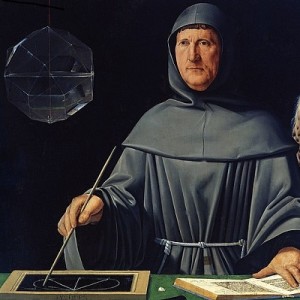
At Wyoming Catholic, you can tell when geometry test is in the offing. Triangles, circles, and lines along with the propositions that go with them cover every spare white board and occasionally some windows as well as students discuss the diagrams with one another.
Plane geometry—that is, the geometry of two dimensional figures comes first. After that students make the quantum leap in to solid or three-dimensional geometry including perfect solids and conic sections.
In the classroom, many are taught by Dr. Henry Zepeda. Dr. Zepeda who joined the Wyoming Catholic College faculty this year is our guest this week on The After Dinner Scholar.
Jan 1, 2019
Jan 1, 2019
19 min
“What does it mean to be wise?” a psychologist recently asked an 8-year-old and an 88-year-old from different parts of the world. “Their answers,” she reported, “were remarkably similar: to know a lot.”
If wisdom was simply a question of knowing a lot, we would need to conclude that Americans today are by far the wisest generation to live. After all, thanks to the internet, we know a lot about a lot of things. But is access to knowledge, to data really the definition of wisdom? Isn’t wisdom more a matter of how we live than about what we know?
Of the 73 books in our Bibles, we classify seven as “wisdom books.” Those are Job, Psalms, Proverbs, Ecclesiastes, Song of Solomon, Wisdom of Solomon, and Sirach. And for most people, aside from Psalms, the books seem rather elusive.
To help us understand wisdom and the wisdom books as we embark on a new calendar year, we’re joined by theologian Dr. Jeremy Holmes.